On October 21, 2026, two of the most consequential cybersecurity events of the year unfolded within hours of each other. A pair of critical memory corruption flaws in PHP's core interpreter—collectively branded "PHP2Shell"—exposed approximately 69% of the world's websites to unauthenticated remote code execution. Simultaneously, attackers compromised the release pipeline of LiteLLM, one of the most popular AI development packages on the Python Package Index, and pushed a weaponized version to approximately 95 million monthly downloaders.
These were not theoretical risks disclosed in an academic paper. They were active, exploitable vulnerabilities affecting production infrastructure at global scale. Understanding what happened, why it matters, and how to protect yourself is essential whether you are a developer, a business owner, or simply someone who uses the internet.
PHP2Shell: Two Memory Corruption Flaws That Threatened 69% of the Web
What Is PHP, and Why Does It Matter?
PHP is the server-side programming language that powers the majority of the web. According to W3Techs, PHP is used by approximately 69.3% of all websites whose server-side language is known—including every WordPress site, most e-commerce platforms, and countless enterprise applications. If the internet has a foundational building material, PHP is it.
The Vulnerability: CVE-2026-109618 and CVE-2026-109619
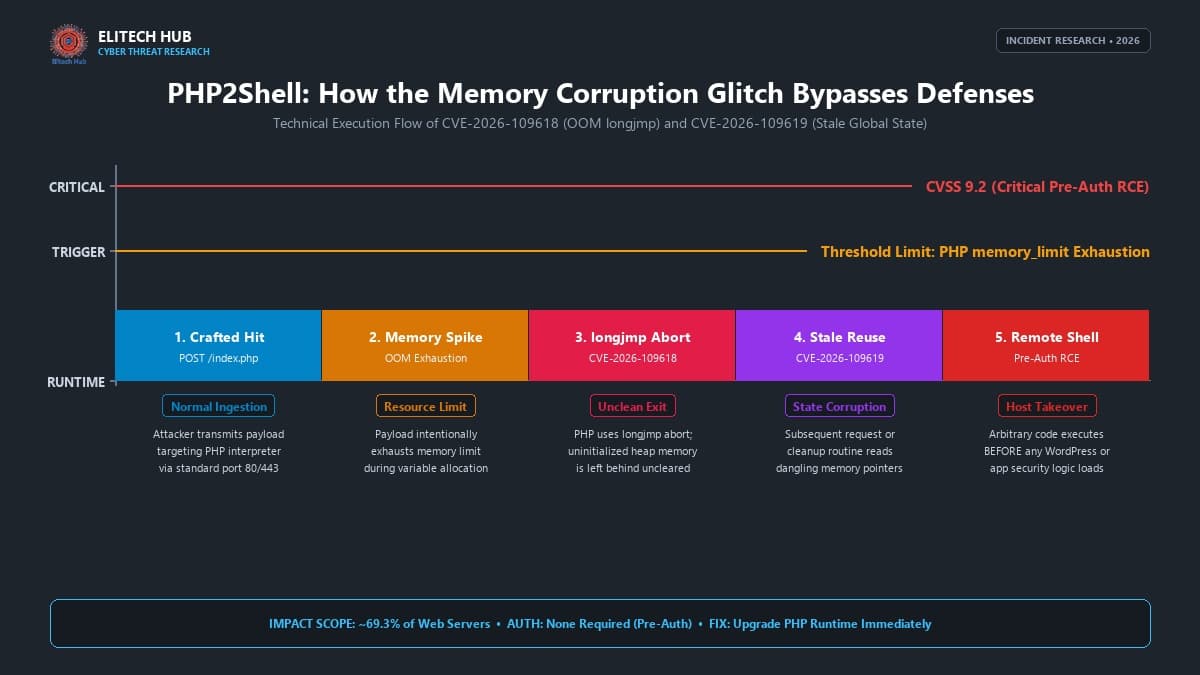
Security researchers discovered two critical flaws in how PHP's interpreter handles memory during request processing. Both were assigned a CVSS score of 9.2 (Critical) and collectively branded "PHP2Shell" because of the direct path they create from a simple web request to full server compromise.
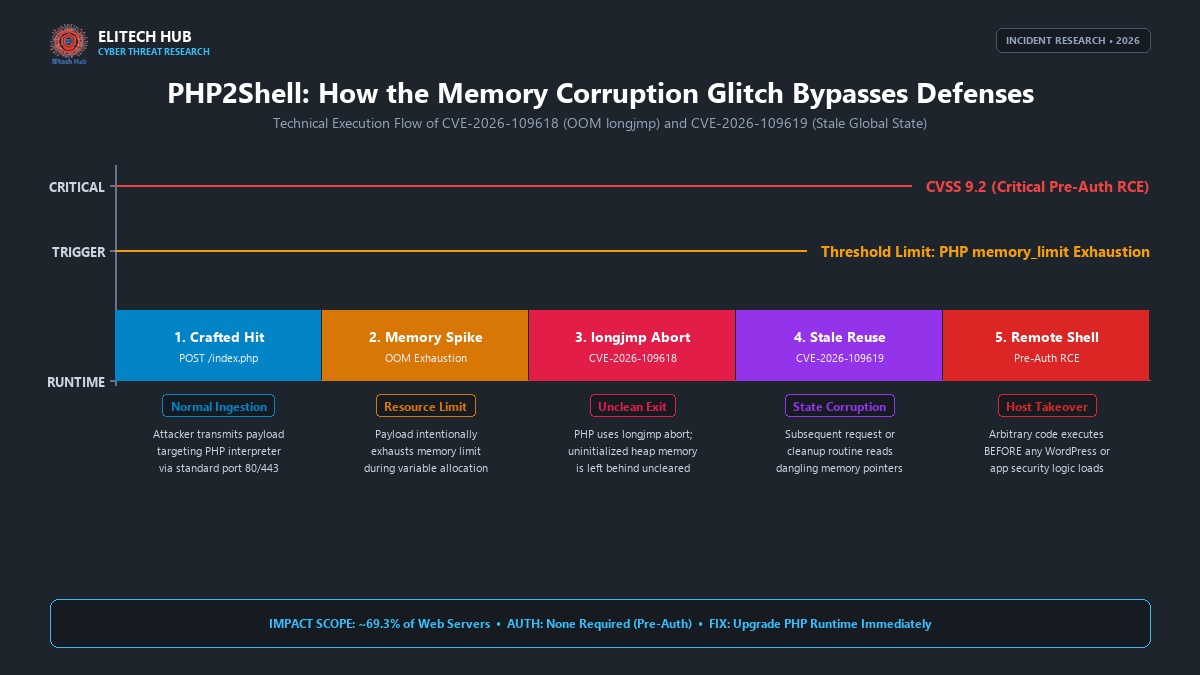
CVE-2026-109618 (Out-of-Memory Corruption): When PHP hits its memory limit while initializing request data, it uses a mechanism called longjmp() to abort execution. The problem is that this abort leaves internal data structures partially initialized, containing stale or corrupted heap data. During the subsequent cleanup routine, PHP reads and branches on this uninitialized memory—creating a window for an attacker to achieve code execution.
CVE-2026-109619 (Stale Global State): Internal request state pointers in PHP can persist or point into freed memory after a request completes. When the same worker process handles a new request, it can access this stale state before it is reset, leading to memory corruption that an attacker can exploit for pre-authentication remote code execution.
Think of it this way: imagine a hotel where a guest checks out, but the electronic lock system glitches and fails to reset. The next person who walks up to that door finds it unlocked—and has full access to everything inside. PHP2Shell is that glitch, except the "hotel" is a web server, and the "everything inside" includes databases, user credentials, and complete control of the machine.
Why PHP2Shell Was So Dangerous
- Pre-Authentication Exploitation: In environments using Apache with
mod_php, PHP-FPM, or LiteSpeed, the exploit triggers before a single line of the website's application code executes. No login required. No interaction with the website's business logic needed. The vulnerability sits in the language runtime itself. - Massive Attack Surface: With PHP powering an estimated 69% of server-side web applications—including WordPress, which alone accounts for over 40% of all websites—the number of potentially vulnerable servers numbered in the tens of millions.
- Trivial Exploitation: Security firms including CrowdStrike and Imperva reported that proof-of-concept exploits were straightforward to develop, prompting emergency patching advisories from government cybersecurity agencies worldwide.
The Fix
The PHP project released emergency security patches on October 21, 2026, covering PHP versions 8.2.35, 8.3.36, 8.4.27, and 8.5.12. Major cloud providers and WAF vendors—including Cloudflare, Akamai, Microsoft Azure, and Fortinet—deployed virtual patching rules within hours. If you run any PHP-based application, verifying that your server has been patched is not optional. It is urgent.
LiteLLM Supply Chain Attack: The Poisoned Package That Targeted the AI Ecosystem
What Is LiteLLM?
LiteLLM is an open-source AI gateway and proxy that provides a unified interface for developers to call over 100 large language model (LLM) providers—including OpenAI, Anthropic, Google Gemini, and AWS Bedrock—through a single, standardized API. With over 60,000 GitHub stars and approximately 95 million monthly PyPI downloads, it is one of the most widely adopted building blocks in the AI development ecosystem. Enterprises and startups alike rely on it to manage costs, load-balance across providers, and switch models without rewriting application code.
The Attack: Credential Theft, Pipeline Compromise, and Weaponized Code
Unlike PHP2Shell—which exploited accidental bugs in source code—the LiteLLM incident was a deliberate, targeted supply chain attack. The attackers did not find a vulnerability in LiteLLM's code. Instead, they stole the keys to the kingdom.
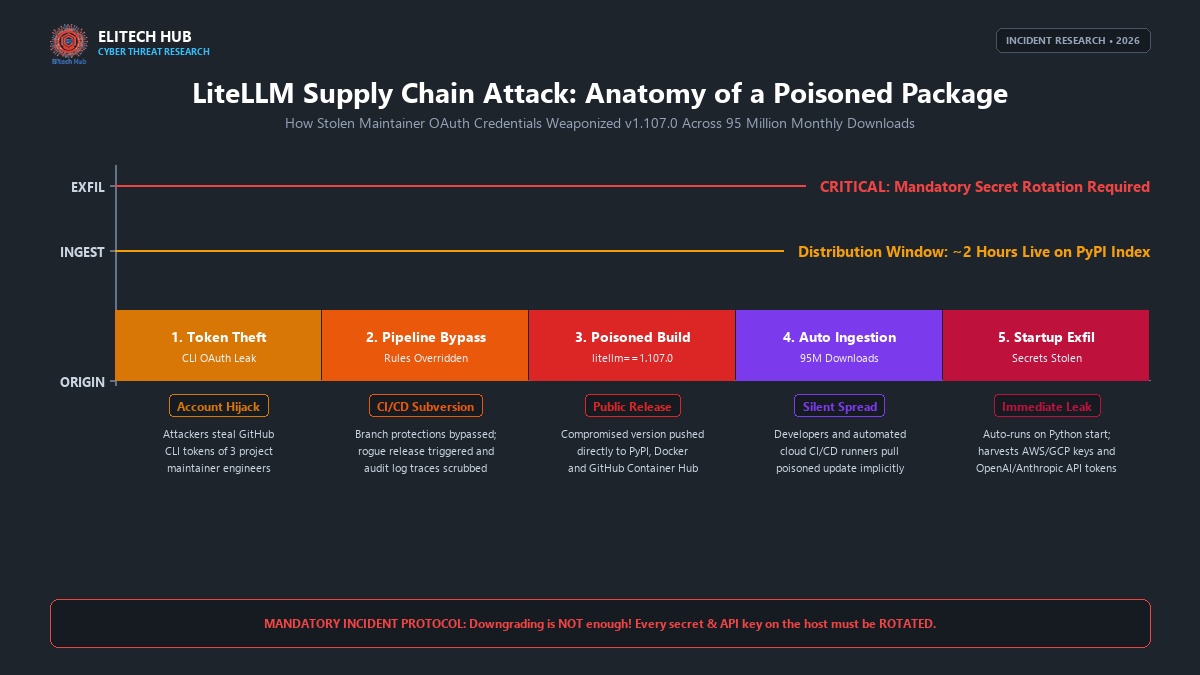
According to LiteLLM's incident response disclosure, the attackers obtained stolen GitHub CLI OAuth tokens belonging to three of the project's engineers. With these tokens, they bypassed branch protections, altered CI/CD workflows, triggered and approved a rogue release, and cleared audit logs to cover their tracks.
The result was version 1.107.0—a malicious release pushed simultaneously to PyPI, Docker Hub, and GitHub Container Registry on October 21, 2026. The poisoned version contained a multi-stage credential stealer and remote code execution backdoor embedded within compiled code.
What the Malware Did
The payload was engineered to execute automatically at Python interpreter startup—meaning it ran and harvested data even if an application had installed the package but never explicitly imported litellm in its code. Once active, it:
- Exfiltrated cloud provider credentials (AWS, GCP, Azure)
- Harvested AI service API keys (OpenAI, Anthropic, and others)
- Scraped environment variables and local configuration files
- Collected browser session data and stored passwords
The malicious version was live on PyPI for approximately two hours (11:39 UTC to 13:23 UTC) before being identified and pulled. Affected Docker images (v1.107.0, latest, main-latest, and main-stable) were distributed for a slightly longer window.
Why Supply Chain Attacks Are Uniquely Dangerous
The reason supply chain attacks are so effective is precisely because they exploit trust. Developers routinely install packages from PyPI, npm, and Docker Hub as standard building blocks. A single compromised package can instantly propagate malware across hundreds of organizations—without any of those organizations making a security mistake of their own.
As Wiz and other cloud security researchers emphasized: simply updating or downgrading LiteLLM is not sufficient. Any system that installed version 1.107.0 must treat all credentials, API keys, and secrets present on that machine as fully compromised and rotate them immediately.
Two Incidents, One Lesson: The Fragility of Digital Trust
PHP2Shell and the LiteLLM supply chain attack represent two fundamentally different categories of cyber threat—but they share a common theme: the infrastructure we trust implicitly can become the vector of compromise.
| Dimension | PHP2Shell | LiteLLM Supply Chain Attack |
|---|---|---|
| Type | Accidental software bug (memory corruption) | Deliberate supply chain attack (credential theft) |
| Target | PHP runtime (~69% of websites) | Python AI development ecosystem (~95M monthly downloads) |
| Severity | CVSS 9.2 (Critical) | Critical (credential exfiltration + RCE backdoor) |
| Authentication Required | None (pre-auth exploitation) | None (auto-executes at interpreter startup) |
| Remediation | Patch PHP to latest security release | Remove v1.107.0 and rotate all exposed credentials |
Practical Security Recommendations
For Developers and Engineering Teams
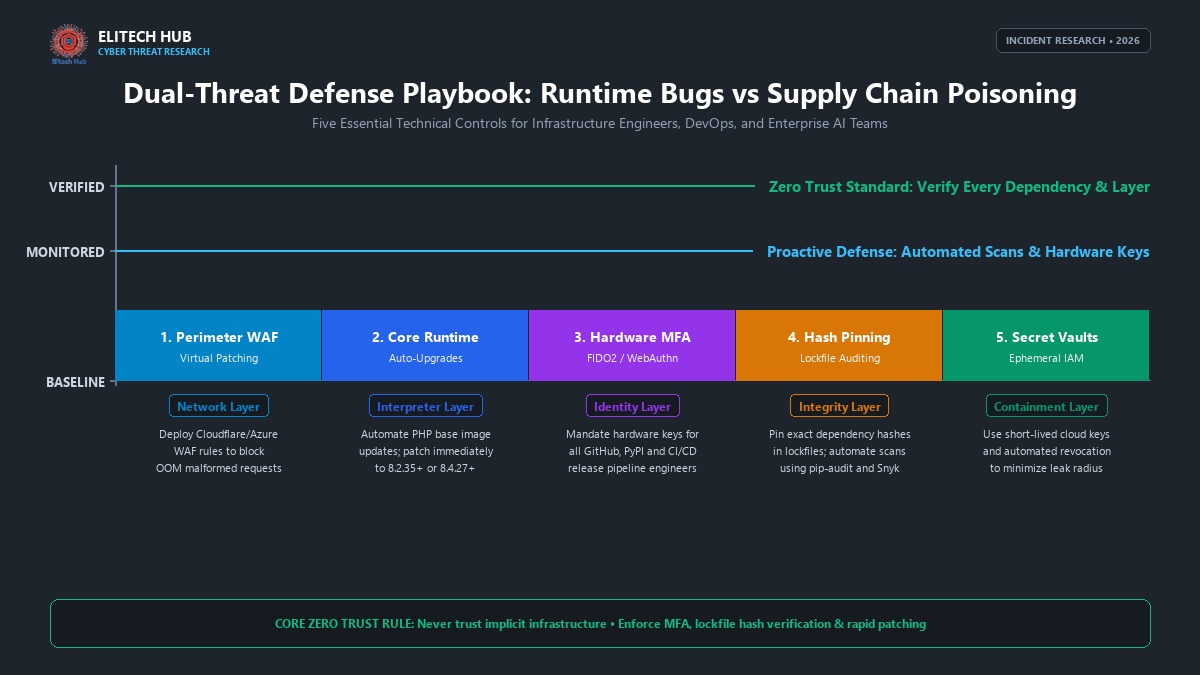
- Patch Immediately: Upgrade PHP to versions 8.2.35, 8.3.36, 8.4.27, or 8.5.12. Verify patches on every server, container, and CI/CD runner in your environment.
- Audit Your Dependencies: Check whether
litellm==1.107.0was installed anywhere in your Python environments. If so, treat every credential on that system as compromised and rotate them. - Enforce Multi-Factor Authentication (MFA): The LiteLLM attack succeeded because stolen OAuth tokens provided pipeline access. MFA on all code repositories, package registries, and CI/CD systems is not a best practice—it is a baseline requirement.
- Pin and Verify Dependencies: Use lock files, hash verification, and tools like
pip-audit,npm audit, orSnykto detect unexpected version changes before they reach production. - Monitor for Anomalous Releases: Subscribe to security advisories for critical packages. A sudden, unexpected version bump—especially with compiled code changes—warrants investigation before deployment.
For Business Owners and IT Decision-Makers
- Confirm Patching Status: Ask your hosting provider or internal IT team to verify that all PHP installations have been updated. If you use managed WordPress hosting, confirm with your provider that they have applied the PHP2Shell patches.
- Review AI Tool Dependencies: If your organization uses AI-powered tools or chatbots, verify with your vendors whether their systems depend on LiteLLM and whether they were affected by the compromised release.
- Implement a Vulnerability Management Process: Establish a documented process for receiving, evaluating, and acting on security advisories within defined timeframes.
For Everyone
- Install Updates Promptly: When your devices, browsers, or applications notify you of security updates, install them as soon as practical. Delayed patching is the single most common reason vulnerabilities are exploited in the wild.
- Use Multi-Factor Authentication: Enable MFA on every account that supports it—particularly email, banking, cloud storage, and developer accounts.
- Stay Informed: Follow credible cybersecurity news sources. Awareness of active threats is itself a form of defense.
For individuals seeking a structured, practical path toward understanding and defending against threats like these, Elitech Hub's Practical Cybersecurity Bootcamp provides a 16-week, lab-focused curriculum covering defensive operations, threat detection, and incident response under professional mentorship. For organizations evaluating their security posture, Elitech Hub's Enterprise Security Advisory offers technical assessments aligned with industry frameworks and current threat intelligence, including technical publications from Elitech Hub's Cyber Threat Research Team.
Frequently Asked Questions (FAQ)
1. What is PHP2Shell and how does it work?
PHP2Shell is the collective name for two critical memory corruption vulnerabilities (CVE-2026-109618 and CVE-2026-109619) in PHP's core interpreter. They allow unauthenticated attackers to achieve remote code execution on web servers by exploiting flaws in how PHP handles out-of-memory conditions and global state cleanup during request processing. The exploit can trigger before any application code runs, making it exceptionally dangerous.
2. Is my website affected by PHP2Shell?
If your website runs on PHP (including WordPress, Laravel, Drupal, Joomla, or any PHP-based CMS or framework) and your server has not been updated to PHP 8.2.35, 8.3.36, 8.4.27, or 8.5.12 (or later), your server is potentially vulnerable. Contact your hosting provider or system administrator to verify patching status immediately.
3. What is a supply chain attack, and why is the LiteLLM incident significant?
A supply chain attack targets the trusted distribution channels through which software is built and delivered, rather than the end user's systems directly. In the LiteLLM incident, attackers compromised the project's release pipeline using stolen developer credentials and injected malware into version 1.107.0. Because developers routinely install packages from registries like PyPI without inspecting every line of code, a single poisoned package can propagate to thousands of downstream systems within hours.
4. I installed LiteLLM 1.107.0. What should I do?
Immediately remove or downgrade the package to a verified safe version (v1.106.2 or the latest clean release). However, removal alone is not sufficient. You must treat every credential, API key, cloud secret, database password, and environment variable that was accessible on the affected system as fully compromised and rotate them all. The malware was designed to exfiltrate credentials silently at Python interpreter startup.
5. How can developers protect themselves from future supply chain attacks?
Key defenses include enforcing multi-factor authentication (MFA) on all code repository and package registry accounts, pinning dependency versions in lock files with hash verification, using automated tools like pip-audit or Snyk to scan for known vulnerabilities, monitoring security advisories for critical packages, and investigating any unexpected version bumps—especially those containing compiled or binary code changes—before deploying to production.